The landscape of higher education is shifting rapidly. As we navigate through 2026, the expectations placed on undergraduate students have evolved far beyond simply “turning in an assignment.” Professors are no longer just looking for the right answers; they are looking for structural integrity, concise communication, and a mastery of academic formatting. Whether you are studying in London, New York, or Sydney, the “word count” remains the most fundamental metric of your academic journey. It is the first boundary set by your tutor and the first hurdle you must clear to demonstrate that you can follow a complex brief.
Understanding the weight of these requirements is essential for long-term success. A word count isn’t just a random number—it represents the depth of research expected for a specific topic. A 500-word reflection requires a different cognitive approach than a 2,000-word argumentative essay. When you ignore these limits, you risk either “fluffing” your paper with meaningless sentences or cutting out vital evidence that could have secured you an A grade. In 2026, where digital literacy and precision are valued above all else, mastering the physical scale of your writing is a core professional skill.
One of the most common points of confusion for students starting a major project is visualizing the final product. You might have a brilliant thesis statement, but if you cannot estimate the physical volume of your work, your time management will suffer. For instance, when you are assigned a substantial term paper, you need to know exactly how much “real estate” you have on the screen. Knowing how many pages is 2000 words helps you divide your essay into logical sections—roughly 200 words for the intro, 1,600 for the body, and 200 for the conclusion—ensuring you don’t run out of space before you’ve made your strongest point.
The Strategic Breakdown: Planning by the Numbers
Effective essay writing is 70% planning and 30% actual typing. When students rush into a 2,000-word assignment without a structural map, they often hit a “wall” at the 1,200-word mark. This is where the quality begins to dip. By treating your word count as a budget, you can allocate specific amounts to your literature review, methodology, and analysis. This prevents the “top-heavy” essay phenomenon, where a student writes a massive introduction but leaves no room for a critical discussion at the end.
To help you visualize this, consider the standard formatting requirements for most global universities in 2026:
| Essay Component | Word Count Allocation (Approx.) | Purpose & Goal |
| Introduction | 10% (200 words) | Hook the reader and state the thesis. |
| Literature Review | 20% (400 words) | Show what other experts have said. |
| Core Argument/Analysis | 50% (1,000 words) | Your unique contribution and evidence. |
| Counter-Arguments | 10% (200 words) | Addressing the other side of the debate. |
| Conclusion | 10% (200 words) | Summarizing findings and final thoughts. |
Navigating the “Quality vs. Quantity” Trap
In the modern era of education, “word salad”—the act of using big words to say very little—is easily spotted by experienced educators and modern grading software. Undergraduate students often feel pressured to use overly academic jargon to sound “smarter.” However, global academic standards now favor clarity and “plain English.” If you can explain a complex economic theory or a biological process in 50 words instead of 100, you should do so. This leaves you more room to include diverse perspectives and stronger citations.
However, many students find themselves in a position where the workload simply exceeds their available time, especially with the rising cost of living forcing many to work part-time jobs while studying. If you find yourself staring at a blank page 24 hours before a deadline, it is okay to seek guidance. Utilizing a reputable college essay writing service through platforms like Myassignmenthelp can provide you with a model paper or structural outline that shows you how to meet these rigorous standards without compromising your mental health or your GPA. Having a professional benchmark allows you to see how a high-distinction paper is actually built.
The Role of Formatting in Professionalism
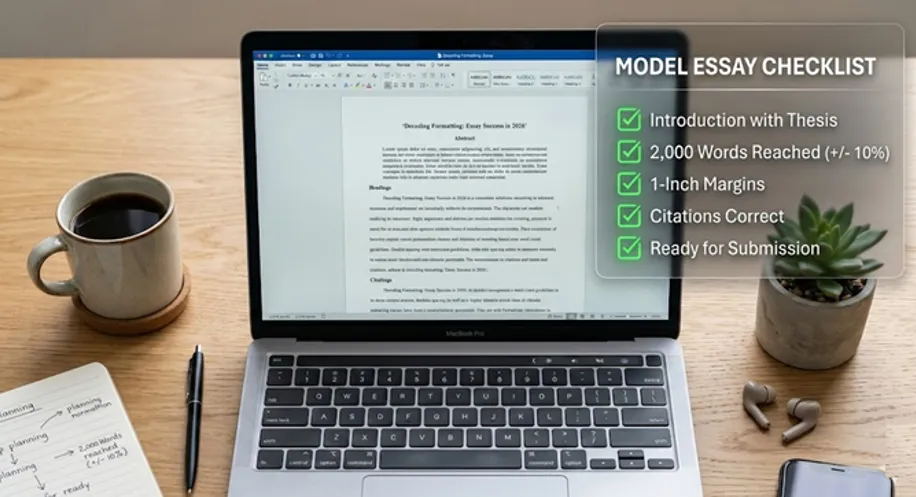
Beyond the words themselves, how those words sit on the page matters immensely. In 2026, “presentation” is considered part of your communication grade. Standard margins (1 inch), double-spacing, and clear font choices (like Arial or Times New Roman) are the industry standards. When an essay is formatted correctly, it signals to the professor that you are a serious candidate who respects the conventions of your field.
A well-formatted 2,000-word essay usually spans about 4 pages if single-spaced or 7 to 8 pages if double-spaced. If your document looks significantly shorter or longer than this, it is a “red flag” that your formatting might be off. Always check your university’s specific style guide—whether it is APA 7th Edition, MLA, or Harvard—before you hit the submit button. These small details often make the difference between a “Pass” and a “Credit.”
Conclusion: Mastering the Discipline of Writing
As you progress through your undergraduate years, remember that word counts are not meant to be restrictive; they are meant to provide a framework for discipline. Learning to expand your thoughts to meet a high word count teaches you how to research deeply. Learning to cut your words down to meet a strict limit teaches you how to think critically and remove the unnecessary.
Frequently Asked Questions
1. Does the bibliography count toward my total word count?
Ans: In most global universities, the reference list, bibliography, and appendices are excluded from the final word count. However, in-text citations usually do count toward your total. Always verify your specific department’s handbook to be certain.
2. Is it better to be slightly under or over the assigned word count?
Ans: Most professors allow a 10% margin. For a 2,000-word goal, staying between 1,800 and 2,200 is generally acceptable. Being too far under suggests a lack of depth, while being too far over indicates a lack of conciseness.
3. How can I increase my word count without using “filler” content?
Ans: The best way to expand an essay is to add more evidence or explore a counter-argument. Instead of using extra adjectives, incorporate a secondary case study or a peer-reviewed quote to strengthen your thesis and provide more value.
4. Does the title and header text affect the length of my essay?
Ans: While titles and headers contain words, they make up a tiny fraction of a 2,000-word document. They are vital for structure and formatting, but you should never rely on them to reach your word count—focus on the substance of your body paragraphs instead.
5. Why are 2,000-word essays so common in college?
Ans: This length is the “gold standard” for testing your ability to move beyond basic facts into critical analysis. It is long enough to require deep research but short enough to demand a tight logical structure, preparing you for professional report writing.
About the Author
Mark Educational Consultant & Career Strategist
I am an educational consultant and career strategist dedicated to helping students navigate the complexities of higher education. My work focuses on providing students with the structural tools and academic strategies they need to excel in a competitive global landscape. Currently, I am associated with Myassignmenthelp, where I specialize in developing high-quality resources that emphasize academic integrity and research excellence.

Ferderik Moller is a passionate blogger with expertise in massages, relationships, and festivals. He shares unique insights, expert tips, and creative ideas to nurture well-being, strengthen bonds, and elevate the joy of celebrations and special moments.