For years, free weights have been the gold standard of strength training. Dumbbells, barbells, and weight plates are basically the backbone of every traditional gym. If you grew up lifting weights, chances are your workouts started there too.
But home fitness has been evolving quickly. More people are moving away from crowded gyms and building workout spaces at home. And when you start thinking about convenience, space, safety, and guidance, the conversation begins to shift.
That’s where smart resistance systems like Speediance come in.
Instead of relying on stacks of metal plates, these machines use digital resistance and intelligent technology to guide workouts. The interesting part? Many of them now include something that traditional gyms never had—an integrated AI Personal Fitness Trainer that helps guide, track, and adjust your workouts in real time.
So the real question isn’t whether free weights work. Of course they do. The better question is whether smart resistance might simply work better for modern home fitness.
Let’s take a closer look.
Traditional Strength of Free Weights
There’s something very satisfying about lifting free weights. The simplicity is part of the appeal. You pick up a dumbbell, perform a movement, and your muscles do the rest. No screens, no complicated setup, no software updates.
Just iron and effort.
Free weights also allow complete freedom in movement. You can perform hundreds of exercises, target every muscle group, and gradually increase weight over time. For experienced lifters especially, this flexibility is a huge advantage.
But once you move that setup into a home environment, things can get complicated.
A proper free-weight setup often means multiple dumbbells, weight plates, bars, a bench, and possibly a rack. Before you know it, your spare room starts looking like a commercial gym.
And there’s also the issue of adjusting weights constantly during workouts. Anyone who has tried circuit training with free weights knows the routine: remove plates, add plates, search for the right dumbbell, repeat.
It works. But it’s not exactly smooth.
The Smart Resistance Shift
Smart resistance training is essentially the next evolution of home strength equipment.
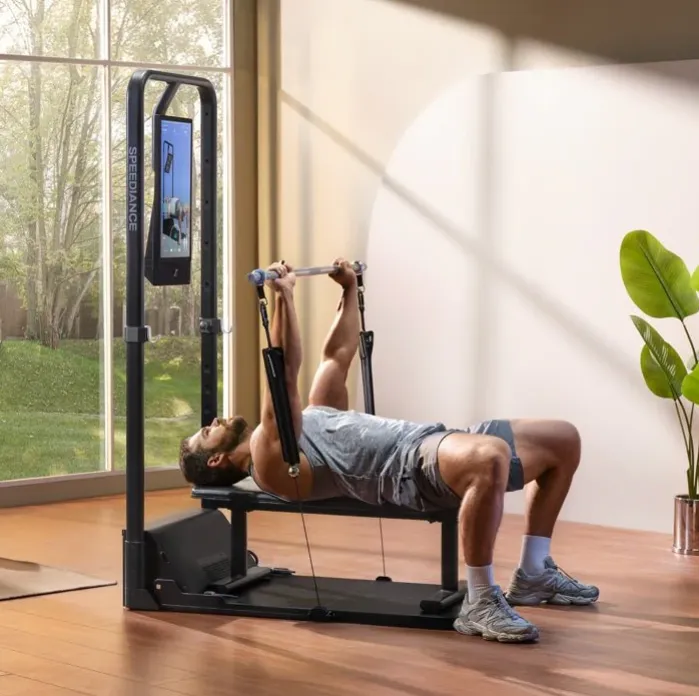
Instead of physical plates, machines like Speediance use digital resistance powered by motors and internal systems. The resistance feels like traditional weight, but the experience is very different.
You don’t walk around picking up dumbbells or swapping plates between sets. The resistance changes instantly with a tap on the screen.
More importantly, many smart gyms now include an AI Personal Fitness Trainer that guides the workout.
This isn’t just a prerecorded video telling you what to do. The system actually monitors performance, suggests resistance levels, and adjusts based on your effort and progress.
In other words, the machine is paying attention.
If you’re pushing hard and performing well, the AI Personal Fitness Trainer may increase resistance to challenge you more. If your form starts to break down or fatigue sets in, it can reduce resistance to keep the movement safe.
That kind of responsiveness simply doesn’t exist with traditional weights.
Efficiency Changes Everything
One thing people often underestimate about smart resistance is how much faster workouts can feel.
With free weights, there’s always a bit of downtime. You finish a set, adjust plates, reposition equipment, maybe grab a different dumbbell, and then start again.
Those little pauses add up.
Smart systems remove most of that friction.
When the resistance changes automatically, you move smoothly from one exercise to another. Supersets and circuit training become far easier because the machine handles the adjustments for you.
The AI Personal Fitness Trainer also keeps the workout structured, which means less time standing around wondering what exercise comes next.
For busy people squeezing workouts into a tight schedule, that efficiency matters a lot.
A Built-In Coach at Home
Another major advantage of smart systems is guidance.
Not everyone knows how to design a proper workout program. Even people who’ve trained before sometimes struggle to stay consistent without structure.
This is where an AI Personal Fitness Trainer becomes surprisingly helpful.
The system can recommend workout plans, guide proper exercise form, and track progress over time. Instead of guessing how much weight you should lift or when to increase intensity, the technology makes those adjustments automatically.
It’s a bit like having a personal trainer standing nearby during your session.
Except you don’t have to schedule appointments or pay hourly fees.
For beginners especially, this guidance can make the difference between giving up after a few weeks and actually building a long-term fitness routine.
Space Is a Real Issue for Home Gyms
One of the biggest challenges with traditional equipment is space.
Dumbbells alone can take up a lot of room if you want multiple weight options. Add a barbell, plates, and a bench, and suddenly your home gym has taken over half the room.
Smart gyms approach this problem differently.
Systems like Speediance are designed to combine dozens of exercises into one compact machine. Instead of buying separate pieces of equipment, everything is built into a single setup.
This makes it much easier to build a functional workout space without turning your house into a warehouse of gym gear.
For families or people living in smaller homes, that compact design is a huge advantage.
And when multiple users can log into their own profiles and follow personalized workouts guided by an AI Personal Fitness Trainer, the home gym becomes something everyone can use.
Motivation and Consistency
There’s another side to fitness that equipment alone doesn’t solve: motivation.
Plenty of people buy dumbbells with good intentions. They use them for a few weeks, then slowly lose momentum.
It happens to almost everyone at some point.
Technology helps bridge that gap.
Smart fitness systems keep workouts engaging through guided sessions, progress tracking, and structured programs. When the AI Personal Fitness Trainer recommends the next workout and tracks your improvement, it creates a sense of progress that keeps people coming back.
It feels less like random exercise and more like following a plan.
And that simple shift can make consistency much easier.
Why Smart Resistance Is Likely the Future
Free weights will never disappear from fitness. They’ve been around for generations, and they still work extremely well.
But home fitness is no longer just about lifting weights. It’s about convenience, personalization, and efficiency.
Smart resistance systems bring all three together.
They combine strength training, intelligent software, and guided workouts into one connected experience. Instead of relying purely on equipment, users get support from an AI Personal Fitness Trainer that adapts workouts based on their progress.
That level of personalization simply wasn’t possible in traditional home gyms.
As technology continues to improve, smart fitness equipment will likely become even more advanced, offering deeper insights into training performance and recovery.
And for many people building a home gym today, that future is already here.
Final Thoughts
When comparing Speediance vs. free weights, the debate isn’t really about which one builds muscle. Both can deliver excellent results when used properly.
The real difference lies in experience.
Free weights offer simplicity and tradition. Smart resistance offers guidance, efficiency, and adaptability through an integrated AI Personal Fitness Trainer.
For many modern households trying to stay healthy without spending hours at the gym, that smarter, more streamlined approach is incredibly appealing.
And as more people experience what smart resistance training feels like, it’s becoming clear that this technology isn’t just a trend.
It’s the direction home fitness is heading.

Ferderik Moller is a passionate blogger with expertise in massages, relationships, and festivals. He shares unique insights, expert tips, and creative ideas to nurture well-being, strengthen bonds, and elevate the joy of celebrations and special moments.