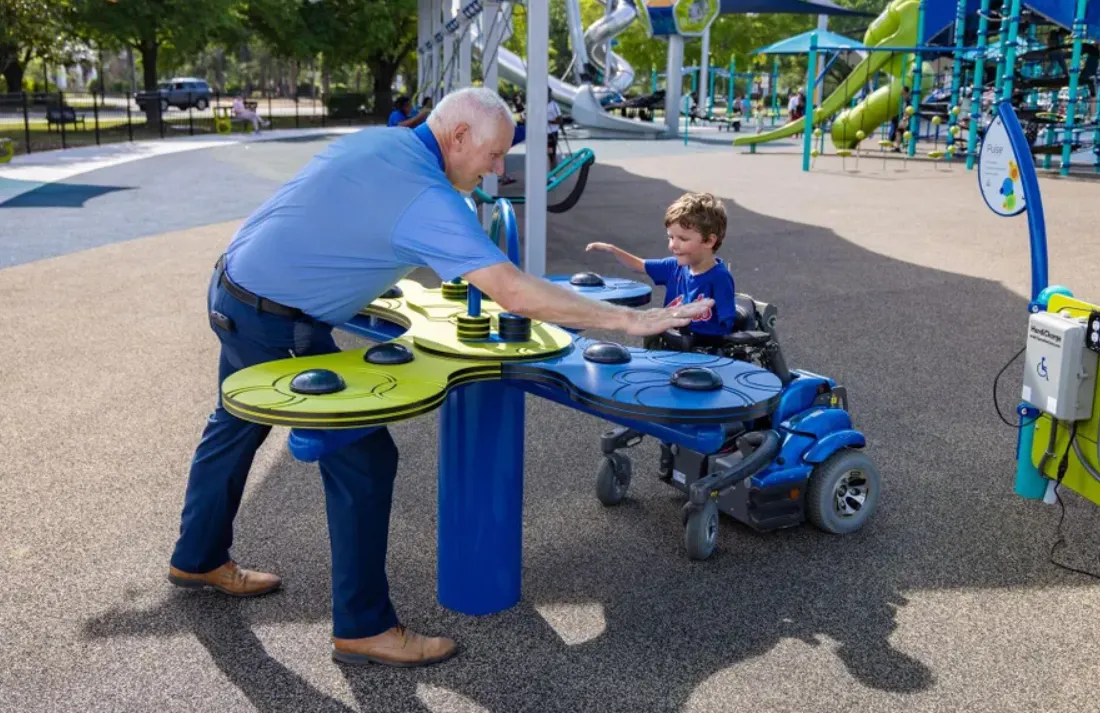
About one in six Australians lives with a disability, according to the Australian Bureau of Statistics. Many of them are children. Traditional playgrounds were not designed with these children in mind. Inclusive play equipment changes that by designing play spaces where every child can participate, regardless of ability, mobility, or sensory need. This is not about adding a wheelchair ramp to a standard playground. It is about rethinking what play access means and building environments where different abilities are not an afterthought.
What Is the Difference Between Accessible and Inclusive Play?
Accessible means a child with a disability can physically enter the space. Inclusive means that child can genuinely participate in the play happening there. The distinction is significant.
A playground with a wheelchair-accessible path leading to equipment a wheelchair user cannot actually use is accessible in the narrowest sense. An inclusive playground designs the equipment so that children with different abilities can play together, not just alongside each other.
What Types of Equipment Are Central to Inclusive Play Design?
Ground-level play panels that engage children in wheelchairs without requiring them to transfer. Inclusive swings with full back and leg support. Wide-pathway climbing structures designed for ambulatory users who need more support. Musical and sensory equipment that engages children with visual or hearing impairments.
Sensory-rich surfaces are important too. Different textures, colours, and materials provide stimulation for children with sensory processing needs. Water play elements, sand areas, and textured climbing grips all contribute to a richer, more inclusive sensory environment.
How Does Inclusive Design Benefit Children Without Disabilities?
This is a question worth asking because the answer shifts the whole conversation. Inclusive design benefits every child. Wider pathways are easier for all children to navigate. Sensory-rich environments stimulate all children more effectively. Lower entry points reduce barriers for younger children and those who are still developing confidence.
Research from the University of Queensland found that inclusive play spaces result in higher-quality social interactions among all children, not just those with disabilities. When the environment does not sort children by ability, children naturally play together in more diverse and collaborative ways.
What Standards Govern Inclusive Playground Design in Australia?
Australian Standard AS 4685 covers equipment safety requirements. The Disability Discrimination Act 1992 requires that public play spaces not discriminate against people with disabilities. The National Construction Code includes access requirements for public spaces.
Beyond legal minimums, the Council on Inclusive Play Guidelines provide a framework for genuine inclusion rather than technical compliance. Meeting the standard is the floor, not the ceiling. Genuinely inclusive spaces go further and ask what it actually feels like to play here if you have limited mobility or a sensory processing disorder.
How Should Site Layout and Surfacing Support Inclusion?
Rubber softfall and wet-pour rubber surfaces provide both safety and accessibility. They are firm enough for wheelchairs and mobility aids to navigate without sinking, and soft enough to cushion falls. Loose-fill surfaces like bark chip fail on both counts for wheelchair users.
Pathway width matters enormously. The Australian Human Rights Commission recommends a minimum 1.8 metre path width to allow wheelchair users to pass each other and to give children who use mobility aids enough space to navigate confidently. Tight pathways create exclusion regardless of how inclusive the equipment is.
How Do You Plan an Inclusive Playground From the Community Up?
The best inclusive playgrounds start with community consultation. That means talking to children with disabilities, their families, occupational therapists, and special education teachers before the design pencil touches paper. They will tell you what actually matters in practice.
Disability groups consistently report that they are consulted too late in planning processes, after the design is effectively fixed. Meaningful consultation happens before design decisions are made, not after. The difference in outcome is significant and the cost of doing it right at the start is far lower than retrofitting a design that does not work.
What Does Good Inclusive Play Look Like in Practice?
A child in a wheelchair using a ground-level sand play table while their friends dig next to them. A child with autism finding calm in a sensory spinner while others play nearby. A child with limited upper body strength navigating a ramp-accessed platform and reaching the slide.
These are not complicated outcomes. They are the result of deliberate design choices that prioritise participation over aesthetics. The playground looks good because it works for everyone, not because it was designed to impress adults viewing it from a distance.

Ferderik Moller is a passionate blogger with expertise in massages, relationships, and festivals. He shares unique insights, expert tips, and creative ideas to nurture well-being, strengthen bonds, and elevate the joy of celebrations and special moments.