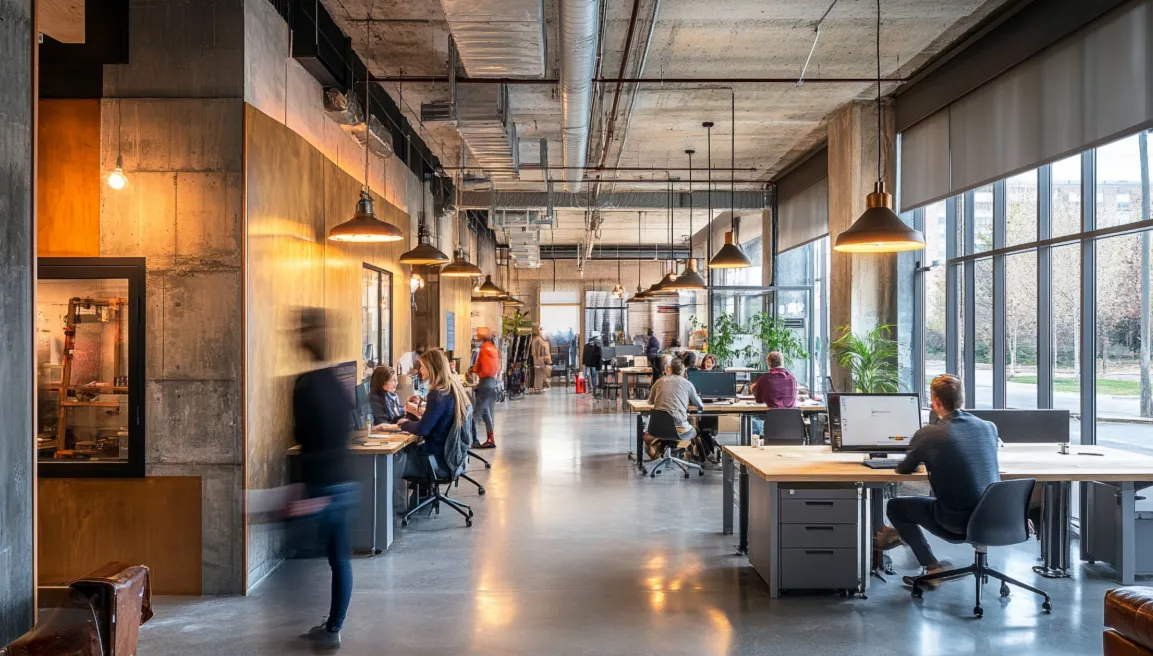
Offices today are no longer treated as static, immovable spaces created simply to accommodate desks, chairs, and storage. Modern workplaces function as living systems that quietly shape how people think, work, focus, and emotionally connect with their organizations. The design of an office does not just influence day-to-day behavior, over time, it leaves a lasting imprint on performance, mindset, and the identity of the business itself.
As the business grows and the work style changes, design choices are becoming more global in terms of the business priorities. Productivity is no longer considered in isolation. It is in coexistence with flexibility, clarity, well-being, and cultural fit. This change has greatly raised the position of the interior designer for office in Noida and Delhi NCR, especially to organizations that are in need of workplaces that can favor not only operational excellence but also an effective interior culture.
The Relationship Between Space and Human Performance
The design of the office has a direct impact on the movement, thinking and communication of the employees during the day. This growing awareness is why organizations increasingly rely on office interior designers in Noidaand Delhi NCR regions to align spatial planning with human performance. Cognitive fatigue is minimized by spatial clarity, and smooth cooperation is promoted by planned circulation. Layouts that are in harmony with workflow patterns have lower mental effort used by the teams navigating friction, interruptions or confusion.
Consideration in spatial planning goes beyond streamlining movement. It helps to bring psychological comfort, which is a key to long-term performance. The availability of daylight, acoustical balance, and proportional spatial volumes affect the mood, attention, and emotional stability. In the long run, these factors influence the capability of an employee to stay active and deliver under pressure.
The physical environment will be supportive of human behavior, in this case, productivity comes out as an innate reaction to conditions.
Organizational Design Signals as Cultural Indicators
All design decisions convey values either consciously or subconsciously. An open working space is an indicator of transparency and accessibility, whereas silent concentration zones serve as a sign of respect to serious, uninterrupted work. Culture is physicalized with the correspondence of the spatial cues with the leadership philosophy and organizational intent.
An office that is well planned minimizes confusion. Through their environment, employees have their own insights on how to act, engage with each other, and what tasks to do and give priority. Such clarity of the environment reduces redundant hierarchy and strengthens autonomy. Organizations do not just follow policy or instruction, but rather, use space to provide direction to behavior and cooperation.
Businesses can provide an environment where the expectations are felt, but not imposed, by investing in coherent interior design.
Space Hierarchy and Kinetic Dynamics
Specific zoning enables the employees to know instinctively where to cooperate, focus or relax in the moment. This transparency causes distraction, and unwarranted movement is minimized all over the office. With a sufficiently defined spatial hierarchy, productivity is organized on its own, without the presence of over-the-top rules and supervision.
The dynamism of movement of people in space (kinetic) is vital to energy and efficiency. Bad circulation causes congestion and interruption, whereas deliberate lines assist in seamless transitions between activities. Offices with a positive attitude towards natural movement patterns have fewer bottlenecks in productivity, and interpersonal coordination is better.
Aesthetic Consistency and Brand Name
Monotony in finishes, colors and language of design reinforces organizational identity. Employees do not feel like isolated units, but they feel part of a system when departments are physically unified, as opposed to being part of disunited segments.
This aesthetic unity creates pride and long-term following. The chances of employees getting emotionally invested in a setting that is characterized by clarity, purpose, and stability are increased. A clearly defined design language makes the brand values stronger within the company so that the culture is not just spoken about every day but also practiced.
The Materiality and Texture Role
The materials have an impact on longevity and the emotional reaction. Smooth, worn-out finishes may facilitate stress in stressful settings, whereas sharp, smooth materials may reinforce concentration and efficiency. The proportion between these extremes helps to specify whether an office can be described as sterile or friendly.
Considerable material choices prevent eye strain even though they guarantee sustainability in the long term performance. The change of texture brings in warmth and does not compromise discipline. Offices are aging on their own time when the choice of materials is based on purpose and not fad, the office is bound to be pertinent as the needs of the organization change.
Innovative Planning of the Modern Work Patterns
The contemporary offices have to sustain various work practices throughout the day. One-on-one activities, group discussions, formal meetings, unofficial discussions, and virtual coordination activities are likely to be present in the same space. Any such activities should not be competing in the same space. This is done effectively through planning.
Zoning plans enable the formation of work modes to flow smoothly. Silent spots are also kept safe, whereas working areas are vibrant. This balance does not oversimulate but rather promotes flexibility, and employees can easily alternate activities as the requirement changes.
Adaptability Is an Important Design Principle
Flexibility has turned out to be one of the important demands of modern office design. Multi-use zones, modular layout, and flexible furniture systems enable organizations to adopt change without always having to renovate them. This vision lowers the expenses in the long run and operation disturbance.
Anticipating growth, restructuring or changing the models of work, the designs safeguard the value of the investment. Rather than responding to change, flexible offices take it in, and there is continuity and stability throughout the business cycles.
Thoughtful Design as a Strategic Business Asset
Designing offices has surpassed being a supporting function or purely done for aesthetic purposes. Office design has emerged as a key asset for enabling behavior and enunciating culture in order to inscribe success in space. A space expertly designed performs as an actor in the success process of an organization.
Well-designed offices integrate people, processes, and purposes in such a way that this physical space adapts and changes as the business does. This perspective increasingly informs how organizations evaluate professional design expertise, including commercial interior designers in Bangalore and Delhi NCR regions, which are corporate hubs in India. In this way, the office itself is transformed from what is essentially an empty space into what is essentially a dynamic system.

Ferderik Moller is a passionate blogger with expertise in massages, relationships, and festivals. He shares unique insights, expert tips, and creative ideas to nurture well-being, strengthen bonds, and elevate the joy of celebrations and special moments.